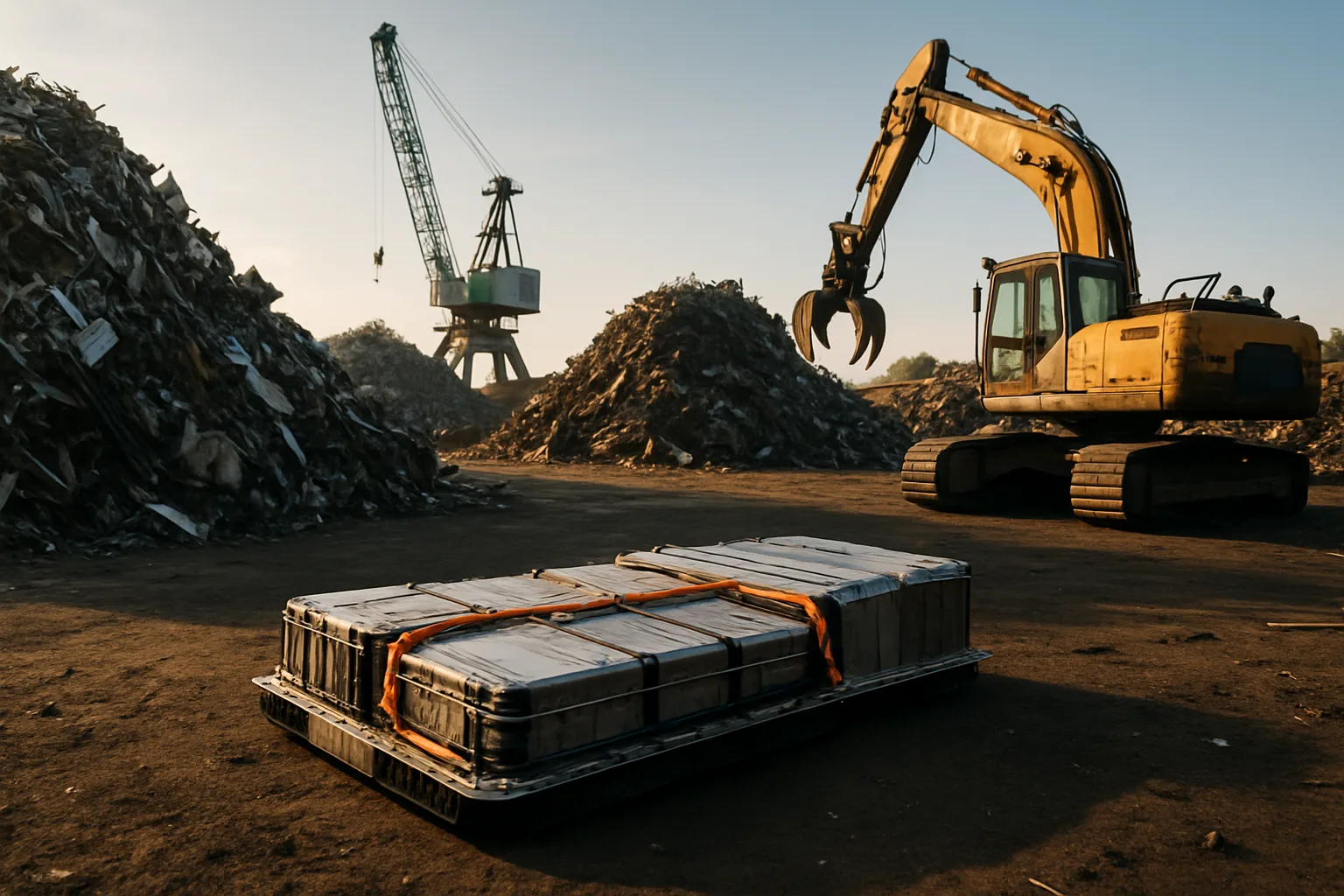
Most EV owners never think about what happens to their battery when the car dies. That's a problem — because electric vehicle batteries don't just disappear, and how you handle an end-of-life EV directly affects how much money you walk away with.
If you're sitting on a dead, damaged, or unwanted electric vehicle in Charlottetown or anywhere across Prince Edward Island, you need to understand what's in that battery pack before you hand the car over to the first buyer who calls. The battery alone can be the difference between a lowball scrap offer and real money in your pocket.
This guide breaks down what happens to EV batteries at end of life, what your car is actually worth, and how to make sure you're not leaving value on the table. Scrap car removal Charlottetown looks different when the car runs on electricity — here's what you need to know.
What's Inside an EV Battery — And Why It Matters for Scrap Value
A modern electric vehicle battery pack isn't just a big AA battery. It's a carefully engineered assembly of lithium-ion cells, copper wiring, aluminum housing, nickel, cobalt, manganese, and sometimes rare earth elements depending on the chemistry. The total weight of a battery pack varies widely — smaller EVs might carry 150–300 kg of battery, while larger trucks and SUVs can exceed 700 kg.
That weight matters. Non-ferrous metals like copper, aluminum, and nickel hold real value in the recycling stream. The challenge is that EV battery packs are hazardous materials — they require specialized handling, storage, and processing. Not every scrap yard is equipped to deal with them, and not every buyer will give you fair credit for what's inside.
Here's a quick breakdown of what typically lives inside a lithium-ion EV battery pack:
- Lithium: Used in the cathode and electrolyte — demand is growing fast as new battery production scales up
- Cobalt: High value, though manufacturers are actively reducing cobalt content in newer chemistries
- Nickel: Increasingly important in high-energy-density cells (NMC, NCA chemistries)
- Copper: Found throughout the wiring, busbars, and cell connections
- Aluminum: The structural housing and many internal components
- Manganese and iron: Present in LFP (lithium iron phosphate) batteries, which are becoming more common
The point is simple: an EV battery pack is a dense concentration of recoverable metals. If you're selling a junk electric vehicle without understanding what's inside, you're negotiating blind.
The Three End-of-Life Paths for EV Batteries
When an EV battery reaches the end of its useful life in a vehicle, it doesn't have to go straight to a smelter. There are three realistic pathways, and which one applies to your car affects the offer you should expect.
1. Second-Life Reuse
Batteries that no longer hold enough charge to power a vehicle reliably — typically below 70–80% of original capacity — can still store energy for stationary applications. Warehouses, solar installations, and backup power systems all use repurposed EV battery modules. If your battery still has usable capacity, it may qualify for a second-life program, which can increase its residual value significantly compared to straight recycling.
2. Remanufacturing and Parts Harvesting
Some damaged EVs still have battery modules in good condition. Salvage buyers and remanufacturers will pay a premium for working modules, battery management systems (BMS), and other recoverable components. If your car was written off due to a collision rather than battery failure, the battery pack itself might be largely intact and valuable as a parts source.
3. Recycling and Materials Recovery
When the battery is truly at end of life — degraded, damaged, or unsafe — it enters the recycling stream. Specialized processors use hydrometallurgical or pyrometallurgical methods to recover lithium, cobalt, nickel, and other metals. Canada has invested significantly in battery recycling infrastructure over the past several years, and the network of licensed processors has grown considerably by 2026.
The key takeaway: your EV isn't just a hunk of steel. It's a complex asset, and the right buyer will evaluate all three pathways before making you an offer. That's exactly the kind of buyer you want to connect with when you get a free car valuation in Canada through a platform that knows what your vehicle is actually worth.
What EV Owners in Charlottetown Need to Know Before Selling
Prince Edward Island has seen steady EV adoption over the past five years, partly driven by provincial incentive programs and the island's manageable driving distances. That means more end-of-life EVs are entering the market on PEI — and not every local buyer is equipped to handle them properly.
If you're trying to sell your junk car or remove an unwanted electric vehicle in Charlottetown, here are the practical things you need to sort out before you call anyone:
- Know your battery state: If the vehicle still powers on or partially charges, document that. A functioning battery — even a degraded one — is worth more than a dead one.
- Have your paperwork ready: Title, registration, and any service records help buyers assess value faster and make stronger offers. If you're dealing with an estate vehicle or a car with a salvage title, note that upfront — buyers like SMASH work with these situations regularly.
- Don't drain or damage the battery intentionally: A punctured or thermally compromised lithium-ion battery is a hazardous materials situation. Leave the battery as-is and let licensed handlers deal with it.
- Get multiple offers: A single call to a single buyer is the old way. Competition reveals actual market value — always.
- Ask about pickup: Many EV removal services in PEI will handle towing and logistics. If they won't, factor that cost into the offer.
Selling an inherited or estate vehicle adds another layer of complexity. If the car belonged to a family member and the title isn't in your name, work with buyers who understand how to navigate that process. You can also browse Canadian car selling tips on our blog for guidance on estate vehicles, salvage titles, and other common scenarios.
How Scrap Car Removal for EVs Differs From Gas Vehicles
Standard scrap car removal for a conventional gas or diesel vehicle is relatively straightforward. Fluids get drained, the catalytic converter gets pulled, steel goes to the shredder, and non-ferrous metals get separated out. The whole process is well-understood, and prices are tied to commodity metal markets.
Electric vehicles complicate this in a few important ways.
Hazardous materials handling: High-voltage battery packs require trained technicians for safe removal. Not every yard has the equipment or certifications to handle this safely, and regulations around EV battery storage and transport are more stringent than for conventional vehicle fluids.
Specialized disassembly: EV powertrains don't follow the same teardown sequence as combustion engines. The battery pack is often structurally integrated into the chassis (particularly on newer platforms), which requires different tools and more time.
Higher non-ferrous content: EVs contain substantially more copper and aluminum than comparable gas vehicles. The wiring alone in a modern EV can weigh several times more than in a traditional car. Buyers who understand this will offer more — buyers who don't will lowball you.
No catalytic converter: If you've heard about scrap value tied to catalytic converters — which contain platinum, palladium, and rhodium — EVs don't have them. That's one source of value that doesn't apply. However, the battery chemistry more than compensates in most cases.
For a deeper dive into the scrap removal process for all vehicle types, explore scrap car removal in Canada at GetMyScrapCar — a useful resource for understanding how the process works from pickup to payout.
Getting More Than Scrap Value From Your End-of-Life EV
The whole premise behind SMASH Cars is that most sellers leave money on the table. That's especially true for electric vehicles, where the difference between a scrap-rate offer and a competitive market offer can be significant.
Here's how you maximize return on an end-of-life EV:
- Document everything: Photos of the battery display, charge level, any warning codes, collision damage, and general condition all help buyers assess accurately — and bid more confidently.
- Research your battery chemistry: If you know whether your car uses NMC, LFP, NCA, or another chemistry, that tells buyers something about residual material value. Check the owner's manual or manufacturer website.
- Separate the question of parts from scrap: A totalled EV might have a perfectly good motor, intact battery modules, charging equipment, or interior components worth more sold separately than bundled into a scrap deal.
- Use a platform that reaches vetted buyers: One call to one junk buyer is a guess. Competitive offers through a structured process is how you find real market value.
Whether you're in Charlottetown, Halifax, Vancouver, or anywhere else across the country, the principle is the same: more buyers means better price discovery. Connect with trusted auto buyers in Canada through SMASH Cars and find out what your EV is actually worth before you agree to anything.
Note: Metal prices and battery material values fluctuate with commodity markets. Always verify current rates before finalizing any sale.
What to Do Right Now If You Have an Unwanted EV
You don't need to be an expert in battery chemistry to sell your car well. You just need to avoid the mistakes most people make: accepting the first offer, skipping the documentation, and treating an EV like a standard scrap car.
Start simple. Take photos. Gather your paperwork. Check whether the vehicle powers on. Then connect with buyers who understand what electric vehicles are actually worth — not buyers who will price it like stripped steel.
If the car has a salvage title, came from an estate, was in an accident, or has been sitting uninsured for months, that's fine. None of those things mean you can't get a fair offer. They just mean you need buyers who work with those situations every day.
SMASH connects sellers with vetted buyers who know how to evaluate complex vehicles — including end-of-life EVs. Get your free offer at smash-cars.ca and see what the market will actually pay. No subscription, no pressure, no guessing.
Stay current on scrap metal market trends and EV recycling developments by following SMASH on LinkedIn: follow SMASH on LinkedIn for industry updates and market insights.
Frequently Asked Questions
Q: Can I get scrap car removal in Charlottetown for an electric vehicle?
Yes. EV removal services operate across Prince Edward Island, including Charlottetown. The process is similar to gas vehicle removal, but requires buyers with proper training and equipment for high-voltage battery handling. Always confirm that the buyer is licensed to handle EV batteries before agreeing to a pickup.
Q: Is an end-of-life electric vehicle worth more or less than a gas car for scrap?
It depends on battery condition, chemistry, and the buyer's ability to extract value from the battery pack. EVs contain more copper and aluminum than comparable gas vehicles, and battery materials can add significant residual value. A buyer who understands battery chemistry will typically offer more than a standard scrap yard.
Q: What if I don't have a title for my junk EV — can I still sell it?
In many cases, yes. Requirements vary by province, and some buyers work with estate vehicles, bill-of-sale-only situations, or other non-standard title scenarios. Be upfront about your situation when requesting offers, and work with buyers experienced in these cases.
Q: How do I find junk car buyers near me in Charlottetown for an electric vehicle?
Start by reaching out through platforms that connect you with multiple vetted buyers — this gives you competitive offers rather than a single take-it-or-leave-it price. SMASH Cars (smash-cars.ca) is a good starting point for reaching buyers who understand EV-specific value factors across Canada.
Q: What happens to the lithium battery from my EV after it's sold for scrap?
Licensed processors recover lithium, cobalt, nickel, copper, and other materials for reuse in new battery manufacturing and other industrial applications. Some packs are assessed for second-life reuse in stationary energy storage before entering the recycling stream. Canada's battery recycling infrastructure has expanded considerably, and regulated end-of-life processing is the norm among reputable buyers.
```