Most people don't realize that selling a deceased family member's car is one of the most paperwork-heavy vehicle transactions in Canada — and doing it wrong can cost you weeks of delays, or worse, expose you to legal liability. If you're dealing with an estate in Kelowna or anywhere else in British Columbia, understanding the title transfer process before you call a buyer is the smartest move you can make.
This isn't just about scrap car removal. Whether the vehicle runs, hasn't moved in years, or was written off before your family member passed, the process of legally transferring and selling an inherited vehicle follows specific rules — and they vary by province. Here's what you need to know in 2026 to do it right and get fair value.
Why Selling an Inherited Vehicle Is Different From a Regular Car Sale
When you sell your own car, the transaction is straightforward. You sign the back of the title, collect payment, and you're done. An inherited vehicle is different because the registered owner is deceased. That means you can't simply hand over the ownership document — the estate must be properly established, or the transfer must follow probate rules before a buyer can take legal possession.
In British Columbia, the Insurance Corporation of British Columbia (ICBC) manages vehicle registration and title transfers. When the registered owner dies, ICBC requires proof of authority before they'll allow a transfer to a new owner — whether that's a family member keeping the vehicle, a private buyer, or a junk car buyer near you in Kelowna. Skipping this step isn't an option. If you try to sell without proper documentation, the deal will fall apart at the transfer stage, and a legitimate buyer will walk away.
Here's the key distinction:
- Estate with a will: The executor named in the will has legal authority to act on behalf of the estate, including selling assets like vehicles.
- Estate without a will (intestate): The court appoints an administrator. That administrator has the authority to sell — but only after the court grants them that power.
- Joint ownership: If the vehicle was jointly owned (e.g., husband and wife), the surviving owner typically has a simpler transfer process — but still requires documentation at ICBC.
Documents You Need Before You Can Sell a Deceased Person's Car in BC
Getting your paperwork in order upfront saves you from scrambling later. Junk car buyers near you in Kelowna — especially legitimate ones — will ask for proof that you have legal authority to sell the vehicle. Don't be offended by that. It protects you as much as it protects them.
Here's what you'll typically need to complete a vehicle title transfer through an estate in British Columbia:
- The original death certificate — issued by Vital Statistics BC. A certified copy is acceptable. Photocopies are not.
- Proof of executor or administrator authority — this is your Grant of Probate (if there's a will) or Letters of Administration (if there isn't). These are court-issued documents. If the estate is small and meets BC's simplified estate threshold, you may qualify for an alternative process — speak with a notary or estate lawyer to confirm.
- The vehicle's registration document — the current ownership certificate in the deceased's name.
- A completed APV9T Transfer/Tax Form — this is ICBC's standard vehicle transfer form. It must be completed accurately, including the declared sale price, which affects the provincial sales tax calculation for the buyer.
- Vehicle identification — the VIN is required for any legitimate transfer. If the vehicle's paperwork is missing, a VIN lookup can pull the registration history. Platforms that use get a free car valuation in Canada tools often use VIN-based lookups to assess estate vehicles quickly and accurately, even for older or non-running units.
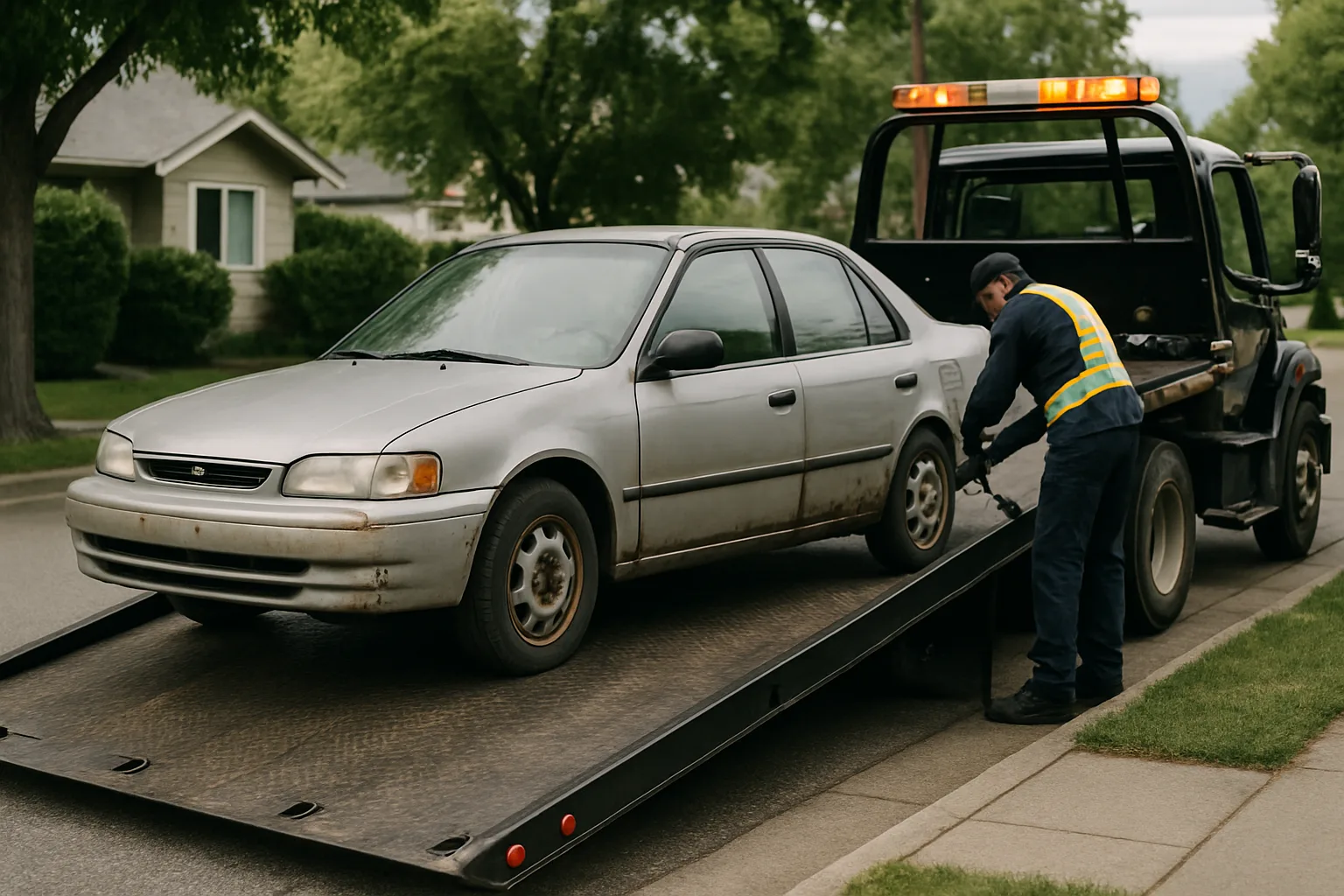
If the vehicle is uninsured (which is common with estate cars that have been sitting), that does not prevent the sale — but it does mean the car cannot be driven to a new owner. Arrange for towing or flatbed transport. Many free junk car removal across Canada services handle this directly, which removes one more logistics headache during an already difficult time.
What's the Car Actually Worth? Understanding Value for Estate Vehicles
Estate vehicles often sit for months — sometimes years — before a family gets around to selling them. That affects value. A car that ran fine two years ago may now have a dead battery, flat-spotted tires, or a seized brake caliper. A vehicle that wasn't maintained can deteriorate quickly in the Okanagan climate, where hot summers and cold winters both take a toll on rubber, seals, and fluids.
That said, "worth less than it was" doesn't mean "worth scrap only." Many estate vehicles — even older, high-mileage units — still have meaningful value beyond their raw metal weight. Factors that affect what you can realistically get include:
- Year, make, and model — demand for parts varies significantly. A late-model pickup from a popular brand holds value better than an obscure import.
- Condition of the drivetrain — even a non-running vehicle with a good engine or transmission has salvage value.
- Body condition — rust, collision damage, and structural issues all affect what buyers will pay.
- Title status — a clean title, even in an estate, typically gets you more than a salvage or rebuilt designation.
- Mileage — lower-mileage estate vehicles sometimes surprise families with their value. Don't assume the worst.
The old approach — calling one local junk yard and accepting whatever number they quote — leaves money on the table. Competition changes the equation. When multiple buyers compete for the same vehicle, you get closer to actual market value. That's exactly why connect with trusted auto buyers in Canada through SMASH Cars — the competitive offer model means you're not locked into one buyer's lowball opening number.
Scrap Car Removal in Kelowna: What the Process Looks Like
For families in Kelowna and the broader Central Okanagan region, the logistics of removing an estate vehicle are usually manageable — but only if you work with buyers who know how to handle estate situations. Not every buyer does. Some will balk the moment you mention that the vehicle isn't in your name yet. The right buyer will walk you through what they need and wait for you to get the paperwork in order.
Here's how a typical estate vehicle removal through a buyer network works in 2026:
- You provide the VIN and describe the vehicle's condition. Photos help. Document everything — interior, exterior, under the hood if possible. This speeds up the valuation process.
- You receive an offer. A good offer accounts for the vehicle's actual salvage value, not just its weight in metal.
- You confirm your paperwork is in order. The buyer will want to see executor authority and the death certificate before the transaction closes.
- Pickup is arranged. Most legitimate buyers will tow or flatbed the vehicle from wherever it's sitting — a driveway in Kelowna, a storage lot, a family property in rural British Columbia.
- Payment is issued and transfer documents are completed. The transfer is filed with ICBC, clearing the vehicle from the estate.
For families managing multiple estate assets at once, having a process this structured is genuinely useful. You don't need to chase the buyer — they come to you. If you want to browse Canadian car selling tips on our blog, you'll find additional guidance on what to expect at each stage of the sale.
Common Mistakes That Delay — or Kill — an Estate Vehicle Sale
After years of watching estate vehicle sales go sideways, a few mistakes come up repeatedly. Avoiding them saves you time, money, and frustration during an already stressful process.
Mistake 1: Selling before establishing legal authority. You cannot legally sign over a vehicle that isn't in your name, and the estate hasn't yet been formally administered. Any buyer worth working with will flag this. Get the Grant of Probate or Letters of Administration first.
Mistake 2: Accepting the first offer without shopping it. One call to one yard is not a market. Estate vehicles — especially older trucks, vans, and SUVs common in interior British Columbia — often have more value than the first caller suggests. Get multiple offers.
Mistake 3: Letting the vehicle sit too long. Every month a car sits outside depreciates its value. Rodents nest in engine compartments. Moisture gets into electronics. Tires crack. Move quickly once the paperwork is ready.
Mistake 4: Missing the ICBC notification requirement. If the vehicle is registered in BC, the estate is required to notify ICBC of the owner's death and initiate the transfer process even before a buyer is found. Failing to do so can complicate insurance and liability questions while the car sits unsold.
Mistake 5: Not accounting for the vehicle's actual condition in the offer. Document damage before the buyer arrives. If there's pre-existing damage — collision, mechanical failure, fire — disclose it upfront. It builds trust and prevents renegotiation on pickup day.
If you're managing an estate vehicle in Kelowna and aren't sure where to start with local logistics, Kelowna scrap metal services can help you navigate both the paperwork stage and the actual removal.
Getting More Than Scrap Value for an Estate Vehicle
The instinct for many families is to treat an old, unwanted, or damaged vehicle as scrap — a flat rate per tonne and done. That's understandable. It's simple, it's fast, and it removes the car from the property. But "scrap value" is a floor, not a ceiling.
A 2015 pickup in rough shape with a seized engine still has parts value. The tailgate, the interior, the axles, the catalytic converter — all of it has a buyer somewhere. The question is whether you reach that buyer or whether you let a middleman capture the margin instead. Platforms like SMASH are built to close that gap. By connecting estate executors and family members with a vetted network of buyers who compete for the vehicle, you get closer to what the market will actually bear — not what one yard decided to offer on a slow Tuesday morning.
Dealing with a loved one's estate is hard enough without leaving money on the table. If you're ready to move the vehicle and want a fair process, connect with trusted auto buyers in Canada through SMASH Cars and get a no-obligation offer. No subscription fees, no pressure — just a straightforward path from paperwork to payment.
Frequently Asked Questions
Q: Can I sell a deceased family member's car without going through probate in BC?
In some cases, yes. British Columbia has a simplified process for small estates that may allow you to transfer a vehicle without full probate. However, the threshold and qualifying conditions depend on the total estate value and asset types. Speak with a notary or estate lawyer in Kelowna or your area to confirm whether you qualify. Most legitimate buyers will still require some form of authority documentation before completing the transfer.
Q: How long does scrap car removal in Kelowna typically take once paperwork is ready?
Once you have your executor documentation and the vehicle's registration in hand, the actual removal can often happen within a few business days. The paperwork stage — obtaining probate or letters of administration — is usually what takes the most time, sometimes several weeks or longer depending on estate complexity. Don't wait until the last minute to start that process.
Q: What if the deceased family member's car has no title or the registration is expired?
An expired registration doesn't prevent a sale, but a missing title does complicate things. In British Columbia, you can apply for a replacement ownership document through ICBC as part of the estate administration process. A VIN lookup can help establish the vehicle's registration history. Work with a buyer who has experience handling estate vehicles — they'll know what documentation ICBC will accept.
Q: Do I need to insure the vehicle before selling it as part of an estate?
No. An uninsured vehicle can still be sold — it simply cannot be driven on public roads. Arrange for flatbed or tow pickup rather than driving the vehicle to the buyer. Many buyers offering junk car removal services in Kelowna will handle the towing at no cost to you, which removes that barrier entirely.
Q: Will I get more than scrap value for an estate car that doesn't run?
Potentially, yes. A non-running vehicle still has parts value, and the actual offer depends heavily on the year, make, model, and condition — not just its weight in metal. Getting multiple offers is the best way to understand what the market will pay. Platforms that connect you with multiple vetted buyers give you a much clearer picture of actual value than a single phone call to one yard.
Follow SMASH on LinkedIn for scrap metal market updates, industry news, and tips on getting the most from your vehicle sale: SMASH on LinkedIn.
```